
In a world where machines can think, create and predict, what remains uniquely human?
A philosophical exploration of intelligence, identity, power and purpose in the age of artificial intelligence.

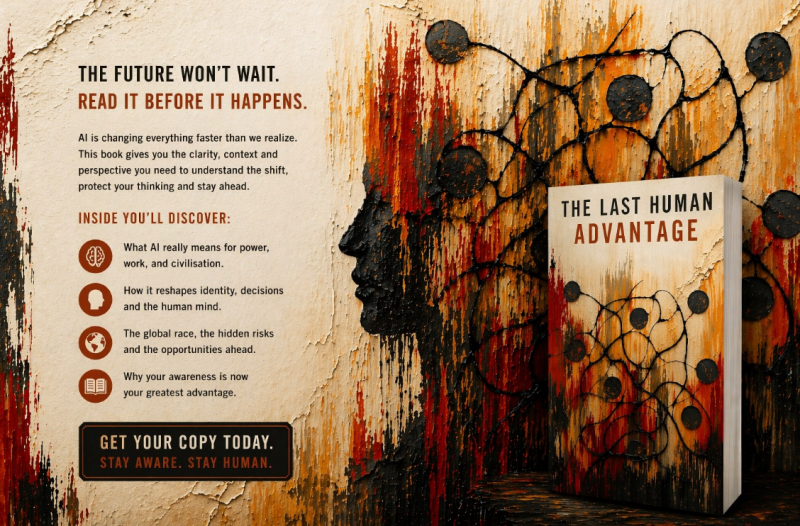
This Is Not a Book About Technology
This is a book about what remains when technology surpasses us.
As artificial intelligence accelerates beyond human capability, writing, reasoning, predicting, the question is no longer what machines can do.
The question is: What is left for us?
The Last Human Advantage explores the foundations of civilisation,
work, intelligence, truth, power, identity and asks what happens when each is reshaped by systems that do not think like us, yet outperform us.
WHY THIS BOOK MATTERS
“Technology does not remove meaning from the world. It removes the conditions that once forced us to create it.”
Anusha Aukhaj, Author

The Shift Has Already Begun
We are entering a world where intelligence is no longer scarce, creativity is no longer uniquely human, knowledge is instantly accessible and decisions are increasingly automated. This is not a distant future scenario, it is already unfolding around us now. In such a landscape, without awareness, identity becomes reactive, shaped by forces we do not fully see, and without intention, meaning begins to drift, gradually outsourced to the systems we rely on. The Last Human Advantage is a call to confront this shift directly, before it quietly defines who we are and who we become.
The Quiet Restructuring

About the book
The core premise
Delve into the fundamental shift brought about by artificial intelligence, exploring how human intelligence is no longer unique. Understand the implications for society, power dynamics and individual identity in this new era.
Societal impact
Examine the quiet restructuring happening beneath our everyday lives, from changes in value creation to new definitions of what it means to be human. This book uncovers the profound responsibilities that come with this transformation.
Beyond technology
While technology is the catalyst, "The Last Human Advantage" focuses on civilisation itself. It's a deep dive into the human experience when machines can perform almost any task, highlighting the invaluable essence of humanity.
A call to reflection
The book encourages readers to reflect on what truly matters in a world increasingly dominated by artificial intelligence. It champions the unique qualities that make us human, emphasising their growing importance and value.
Key themes explored
Discover the intricate web of themes, including power structures, economic value and the very definition of identity in an AI-driven world. Each chapter challenges conventional thinking and offers fresh perspectives.
The author's perspective
Gain insights from the author's extensive research and unique viewpoint on the future of humanity. Explore thought-provoking analyses that will reshape your understanding of our evolving relationship with technology.
Future implications
Consider the long-term impact of AI on human society and personal lives. The book offers a comprehensive vision of what lies ahead, urging readers to prepare for a world where human attributes are the ultimate advantage.
Why read this book?
If you're seeking to understand the profound shifts occurring in our world and your place within them, this book is essential reading. It's a guide to navigating the complexities of the AI age with wisdom and foresight.

Chapter 3: The Illusion of Intelligence
For centuries, intelligence was treated as a hierarchy. Measured. Tested. Ranked. It determined status, opportunity and power. But artificial intelligence does not simply challenge this hierarchy, it dissolves it.
When a system can produce answers instantly, the value of having answers changes. When knowledge is everywhere, knowing becomes ordinary. And when machines can simulate reasoning, we are forced to confront an uncomfortable possibility:
That what we called intelligence was never as rare as we believed.
Perhaps it was not intelligence that made us valuable.But the meaning we attached to it.
Chapter 9: The Quiet Collapse of Identity
For most of modern history, identity has not been discovered.
It has been constructed.
For most of modern history, identity has not been something discovered, but something constructed through participation in systems that required definition. Individuals were understood through what they did, what they produced, and what they contributed. A role provided structure, a profession offered recognition, and a career gave direction. These were not superficial labels but anchors that grounded the individual within society. As these anchors begin to loosen, something deeper begins to shift, revealing that identity was not simply internal, but shaped by the structures that surrounded it.
Identity as Social Position
Identity has long existed as a relationship between the individual and the structures they inhabit. Society assigns roles, roles create expectations, and expectations shape behaviour. Through this process, identity emerges not as a purely internal construct, but as a position within a network of meaning. Statements such as “I am a lawyer,” “I am an engineer,” or “I am a teacher” do more than describe activity; they situate the individual within a system that defines purpose and value. Artificial intelligence does not remove identity, but it destabilises the conditions through which it is formed, weakening the structural foundations that once made identity coherent.
Reader's Thoughts
"This book is a profound and timely exploration of what it means to be human in the age of AI. A must-read for anyone concerned about our future."
Dr. Anya Sharma
"An incredibly insightful and thought-provoking analysis. 'The Last Human Advantage' has completely reshaped my understanding of AI's impact."
Mark Wood
"Essential reading for anyone navigating the complexities of our rapidly changing world. The arguments are compelling and deeply resonant."
Sarah Jenkins
Contact
Anusha Aukhaj
The Last Human Advantage
London, United Kingdom
info@thelasthumanadvantage.co.uk
Website
www.thelasthumanadvantage.co.uk